


Why Chicken Packaging Is More Complicated Than It Looks
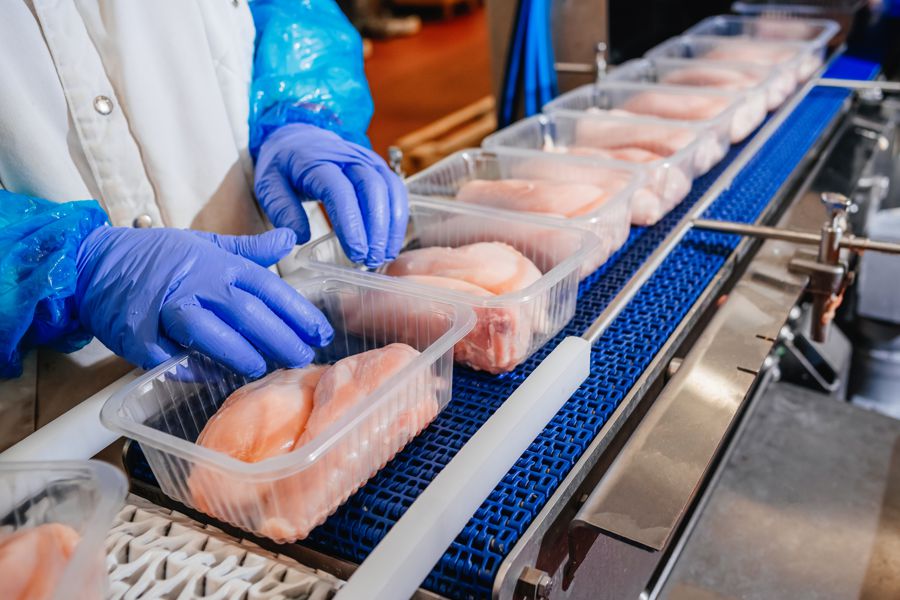
More than 1.16 billion table chickens were slaughtered in the UK during 2025, according to the latest Defra figures. UK poultry-meat production reached just over 2 million tonnes, with output from chickens and other table fowl reaching a historic high of around 1.9 million tonnes. The value of poultry production was £3.367 billion, which gives some idea of the scale involved before a single pack reaches a supermarket shelf. Defra notes that the 2025 figures remain provisional and may be revised.
At that sort of volume, chicken packaging is not simply a question of putting meat into a plastic tray and sealing some film over the top. The pack has to contain a raw food product, help protect it during refrigerated storage and then survive everything that happens between the packing line and the person taking it out of their fridge at home. It also carries information that allows the product to be identified and traced, while the finished packs still have to be moved through a factory, loaded into cases and transported through a large supply chain without being damaged.
The scale of that supply chain extends well beyond UK production. Defra says domestic production accounted for 80% of UK poultry supply during 2025, while the country imported around 700,000 tonnes and exported 212,000 tonnes. This means chicken and chicken products are routinely moving between processors, distribution centres and markets over considerable distances, so packaging has to work reliably long after the product has left the packing machine.
Once you start looking at what the pack actually has to do, chicken packaging becomes a much more interesting engineering problem.
Raw chicken creates a difficult packaging job
Chicken is a raw food product that needs careful handling all the way through production and preparation. Packaging cannot make raw chicken safe to eat, and it does not replace hygiene or thorough cooking, but it does have an important job in keeping the product contained and reducing opportunities for raw juices to spread outside the pack.
The Food Standards Agency’s 2022 survey of chicken and turkey meat sold at retail found Campylobacter in 48% of the chicken samples it examined. Six per cent had Campylobacter levels above 1,000 colony forming units per gram, while Salmonella was found in 2% of chicken samples and ESBL/AmpC E. coli in 12%. The FSA also points out that this is raw meat intended to be cooked and that good hygiene and thorough cooking greatly reduce the risk to consumers.
That distinction is important because it explains part of the job the packaging is doing. A chicken tray needs to remain intact while it is being handled in the factory, packed into an outer case, transported, unloaded and placed into a retail display. A damaged tray or failed seal can allow raw juices to escape onto surrounding packs and surfaces, so protecting the primary pack during the later stages of production is not simply about keeping it looking tidy.
Older research from the FSA shows why the outside of the pack has received attention. During a UK-wide survey carried out between February 2014 and February 2015, Campylobacter was detected on the outer packaging of 6.8% of the fresh whole chickens tested. That figure should not be treated as a current contamination rate because the research is more than a decade old, but it remains useful evidence of why maintaining pack integrity and good hygiene around raw chicken is important.
The final safety step still happens in the kitchen. Current FSA guidance says that poultry should be cooked all the way through, with the centre reaching 70°C for two minutes or an equivalent combination such as 75°C for 30 seconds. Packaging therefore has two connected jobs before that point: keeping the raw product properly contained and giving the person preparing it the information needed to store and cook it correctly.
Keeping chicken fresh adds another layer
Containing the chicken is only part of the job because fresh poultry is also a perishable product moving through a refrigerated supply chain. Temperature control, starting product quality, sealing performance and the atmosphere inside the pack can all influence how long the product remains suitable for sale.
One technology commonly used with fresh meat is modified atmosphere packaging, usually shortened to MAP. Instead of leaving normal air inside a sealed pack, the atmosphere is changed using a controlled mixture of gases. The exact combination depends on the product and the packaging system being used, so there is no single MAP formula that applies to every chicken pack.
A 2022 study published in Poultry Science compared refrigerated chicken leg meat packed under normal aerobic conditions with meat stored in several modified atmospheres. Under the conditions used in that experiment, the researchers reported a shelf life of up to 15 days for the modified-atmosphere packs compared with six days for the aerobically packed samples. This does not mean that any supermarket chicken placed in MAP will automatically last 15 days, because actual shelf life depends on the chicken, the gas mixture, the materials, sealing quality and the conditions throughout distribution. What the study does show is that the packaging atmosphere can make a substantial difference under controlled refrigerated conditions.
This is also why shoppers sometimes see the wording “packaged in a protective atmosphere” printed on food packaging. UK government labelling guidance requires that wording where a product has been packaged using a protective atmosphere.
For a packaging line, this creates another practical consideration because the finished tray has already been designed and sealed to maintain particular conditions around the product. Everything that happens afterwards needs to respect that pack. Rough handling, excessive pressure or a sharp edge in a later process can damage a primary pack that has already completed the most sensitive part of its packaging operation.
The label is doing far more than identifying the product
A modern chicken pack also carries a considerable amount of information, which is easy to overlook when most of us spend only a few seconds looking at the label.
For unprocessed, pre-packed poultry sold to consumers or mass caterers, UK guidance requires information showing the country where the bird was reared and the country where it was slaughtered. If the bird was born, reared and slaughtered in the same country, the label can instead state its origin using that country. Packs must also carry a batch code identifying the meat, and that batch information has to remain with the packaging through transport to the consumer.
Alongside that information, a chicken pack may also carry the product description, weight, use-by date and storage instructions, together with cooking guidance and any information required for the particular product or packing method. The label therefore has a practical role in the traceability system as well as helping the person buying the chicken understand what they are taking home.
This becomes more complicated when a processor is packing different products for several retailers or export markets. The chicken may be very similar, but the printed packaging can change because a different customer wants another pack size or a different label. A factory can therefore be handling several versions of a product even when the basic chicken being processed has barely changed.
From an engineering point of view, this means product identification has to remain correct as production moves through the line. The right primary packs need to reach the right outer packaging, with the correct number of units in each case, because a mistake further down the line can undermine the traceability work that has already taken place.
The finished tray still has a long way to travel
A shopper normally thinks about the chicken tray as the finished package, but from the factory’s point of view it may only be the end of the primary packaging stage.
Those trays or bags still need to move away from the primary packing equipment and through the next part of production. Depending on the application, finished packs may need to be spaced correctly, turned into the required orientation or grouped into specific quantities before they can be loaded into an outer carton or case. Once that case is closed, it has to withstand further handling through storage and distribution.
This is where secondary packaging becomes important. The outer case protects groups of finished packs and makes them easier to handle as a controlled quantity. It can also stop the primary packs moving excessively during transport, which is particularly useful when the product inside is raw food and the tray or film should not be subjected to unnecessary damage.
The physical shape of the primary pack also changes the job. A rigid tray behaves differently from a flexible bag, while pack dimensions can change between product ranges and customers. Jacob White’s own food packaging information describes machinery designed to handle finished food products in formats including trays, bags, tins and sachets, with equipment that can be configured for different sizes and production speeds.
The important point is that Jacob White enters the process after the chicken has been placed into its primary packaging. The tray, sealing film, absorbent components and any modified-atmosphere system have their own specialist requirements. Once that primary pack is complete, the problem becomes one of handling those finished products reliably, collating them and getting them into the correct secondary packaging without undoing the protection already provided by the primary pack.
Using less packaging is not always as simple as it sounds
Chicken packaging also sits in the middle of a difficult environmental discussion because manufacturers are being asked to reduce packaging waste while still protecting a perishable food product.
At first glance, the answer can appear obvious: use less material. In practice, reducing packaging without considering what happens to the food can move the environmental problem somewhere else.
WRAP estimates that UK households wasted around 6 million tonnes of food and drink during 2022, of which 4.4 million tonnes consisted of edible food that could have been consumed. The value of that edible waste was around £17 billion, while nearly 40% occurred because food was not used in time. WRAP also reports that meat and fish are among the food categories associated with the highest greenhouse-gas emissions when they are wasted.
That does not mean more packaging is automatically better, but it shows why the calculation cannot be based only on the weight of the plastic or cardboard around the product. A lighter pack that fails more often, allows leakage or reduces the usable life of the food may save packaging material while creating additional waste elsewhere.
The same applies to secondary packaging. Removing board from a case can reduce material use, but the case still has to protect the primary packs during stacking and transport. If it becomes too weak and trays are damaged before they reach the shop, the saving in cardboard has not necessarily improved the overall result.
Chicken packaging therefore involves a balance between reducing unnecessary material and using enough material to do the job properly. The best answer will vary according to the product, the distance it travels and the type of primary pack being protected.
Recycling chicken packaging has its own problems
Recycling adds another layer because not every material used around fresh food behaves in the same way once the consumer has finished with it.
England’s Simpler Recycling rules are changing what households can expect to have collected. Government guidance says that plastic film packaging and plastic bags will need to be collected alongside plastic recycling from 31 March 2027, which should widen the range of flexible plastics entering household recycling systems. The same guidance also states that some materials are not required in this collection stream, including polystyrene and PVC packaging, as well as plastic packaging labelled compostable or biodegradable.
Fresh-meat packaging can be more difficult than an empty drinks bottle because the pack may involve different materials and it has been in direct contact with raw food. Films need to provide the required performance, trays need sufficient strength, and any changes still have to work with existing sealing and handling equipment.
Even the word “recycled” needs some explanation where food-contact packaging is concerned. In 2025, the Food Standards Agency advised businesses not to use abandoned environmental plastic, including so-called ocean-bound plastic, in food packaging because there was not enough evidence to confirm its safety for food contact. At the same time, the FSA made a distinction for recycled plastic from controlled sources such as UK kerbside collection, which can be used for food packaging when the appropriate safety requirements are met.
This is a useful example of why material choices cannot be reduced to simple labels such as plastic, recycled or biodegradable. A material used for direct food contact has to be suitable for that job, and a change made for environmental reasons still needs to work safely on the production line and through the distribution chain.
Packaging now carries a direct financial pressure as well
The cost of packaging has always influenced design, but UK policy is putting more direct financial weight behind decisions about the materials producers place on the market.
Under the first year of packaging Extended Producer Responsibility, the published 2025 to 2026 base fee was £423 per tonne for plastic and £196 per tonne for paper and card. These figures are scheme base fees rather than a simple charge attached to every individual chicken pack, so they should not be used to conclude that one material will automatically be cheaper than another in a particular application.
The wider principle behind the scheme is that producers take financial responsibility for the collection and disposal of household packaging once it becomes waste. Government policy describes this as moving those costs onto producers under the polluter-pays principle.
This gives packaging designers and manufacturers another factor to consider alongside food protection and production performance. Material choice can influence waste costs, although changing from one material to another is only useful if the replacement can still perform the required job.
For chicken in particular, the product itself sets some demanding conditions. The pack has to deal with moisture and direct food contact, while the finished product remains temperature sensitive. It then needs to survive handling through a production environment where large volumes may be moving continuously. A material that looks attractive on paper can create new problems if it does not seal properly or changes the way finished packs behave when they reach downstream machinery.
Why a simple chicken tray becomes an engineering problem
The interesting thing about chicken packaging is that none of these requirements exists on its own.
The primary pack has to contain raw chicken without leaking while supporting the required shelf life. The label has to identify the product and preserve traceability, and the finished pack must then survive the mechanical handling that follows. Once several primary packs are grouped together, the secondary case has to protect them through storage and distribution without adding unnecessary material or making the line harder to operate.
All of this is happening at industrial scale. Defra’s figure of 1.161 billion table chickens in a single year is useful because it shows how quickly small packaging decisions become large ones when repeated across a sector of this size. A small reduction in damage can represent a substantial quantity of product, just as a small inefficiency repeated across thousands of production hours can become a significant manufacturing problem.
It also explains why changes to packaging cannot be considered only by looking at the pack on a desk. A new tray dimension can affect the way products are collated further down the line, while a different film or lighter container may change the way a pack behaves during handling. Altering the number of products in an outer case can affect the case itself and everything needed to load it consistently.
For businesses involved in downstream automation, that is where the chicken packaging problem becomes particularly relevant. Jacob White Packaging does not need to manufacture the primary chicken tray or create the atmosphere inside it to be part of the process. Its role begins when those finished packs need to be controlled and moved into the next stage of packaging.
A tray of chicken may look like a simple product when it is sitting on a supermarket shelf, but by that point a considerable amount of work has already gone into keeping the product contained, identified and protected. The final outer carton or case is another part of that same job, helping the finished primary packs make the rest of the journey without losing the protection built into them earlier in the line.
That is why chicken packaging is more complicated than it looks. It is not one pack and one machine, but a sequence of connected decisions in which food safety, shelf life, handling, labelling, material use and distribution all influence what happens next.